Gift now or leave a will: pros and cons in Costa Rica

"Better to sign the house over to my son now and save everyone the trouble." It sounds sensible, but anyone asking whether to gift in life or leave a will is choosing between two very different paths.
A will changes nothing while you are alive and you can rewrite it whenever you want. A gift parts you from the asset today and, once accepted, cannot be undone because you changed your mind.
And there is a risk almost nobody wants to look at: what if your son dies before you do? The house does not come back to you. It passes to his heirs, and if he had no will it can end up co-owned by you, your daughter-in-law and your grandchildren, tied up in a court probate for years.
This article compares both paths: what each one involves, what it costs and what it risks. Our position, up front: if you want to keep your assets and be able to change your mind, a will answers that better; gifting answers a different goal, which is letting an asset go today. To place your own case, start with the self-assessment test.
The core difference: today or later
A gift is a contract between living people. You transfer an asset to someone else for free, and they accept it. Once the gift is complete, the asset is theirs; if it is real estate, the deed is then recorded at the National Registry. From that moment they can sell it, mortgage it or lose it to their debts, and you no longer have a say over it.
A will is an act of last wishes. While you are alive it has no effect at all: you remain the owner of everything. It only starts working when you die, and the assets are distributed through a probate proceeding.
Even a "gift to take effect after death" is governed by the rules on wills (art. 1393 of the Civil Code). If you want the asset to pass when you are gone, the instrument is a will.
The useful question is not "which is better?" but "do I want to let go of this asset today, or do I want to decide today what happens to it later?".
The main risk: what if the child you gifted dies first?
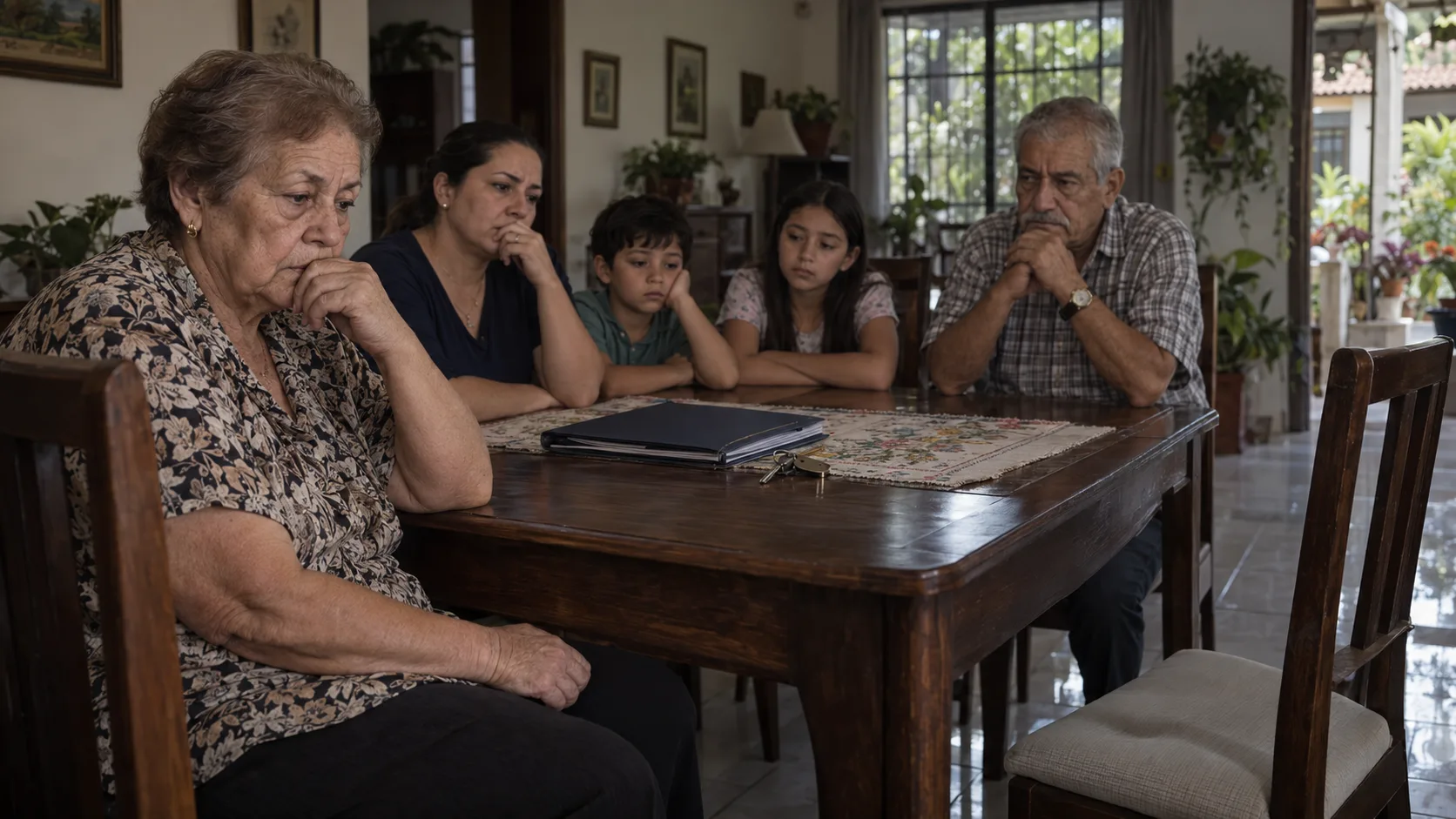
Nobody wants to think about it, but it happens. And when the child who received the house dies before you do, gifting shows its harshest side.
The house does not come back to you. It already belongs to your son, so it passes to his heirs. And you cannot guard against it in the deed: the law forbids agreeing that the asset returns to the donor if the recipient dies first, what is called a reversion clause (art. 1396 CC).
If your son had no will, everyone inherits together. In the first order of intestate succession the deceased’s children, parents and spouse or partner all come in at the same time (art. 572 CC). The house you gifted is split among your grandchildren, your daughter-in-law or son-in-law, you, and your son’s other parent, even if you divorced years ago. A gifted asset not being marital property (art. 41 of the Family Code) protects it in a divorce, but does not stop the spouse from inheriting it.
A simple example: you gifted the house to your son, he married, had two children and died without a will. The house now belongs, in shares, to your two grandchildren, your daughter-in-law, you, and your son’s other parent. Five owners, two of them minors, and none of them chose this. Had your son died single and childless, the house would have gone to his two parents, even if the two of you are no longer together.

If there are minor grandchildren, probate goes to court. It cannot be handled before a notary (Notarial Code, art. 129), and a court probate involving minors can take years. We explain how it works in judicial probate.
And meanwhile, the house is tied up. It stays in your late son’s name, under the executor and the court. Even if you are an heir, you cannot sell it, rent it or mortgage it on your own, nor insure it in your name or make any substantial repairs, without every heir agreeing and, with minors involved, without the judge’s authorization. If you are an older adult, that can mean spending the very years when you would most need that house —to pay for care or top up your pension— unable to do anything with it.
How to reduce this risk
- Have the child who receives it make their own will. It is the simplest protection: it decides who gets the house if he dies. It cannot be imposed as a condition of the gift, but it can be done at the same time.
- Reserve the usufruct for yourself. If you gift the bare ownership and keep a life usufruct, your right to live in the house stays out of your son’s estate. It does not keep the bare ownership out of his probate, but it does keep you from losing your home. See reserved usufruct.
- Do not gift, and leave it in your will. If your son dies before you, you adjust your will and decide again.
- A trust, when the estate justifies it, sets out from the start what happens if a beneficiary dies. See trust vs. will.

What gifting in life involves
Gifts are governed by articles 1393 and following of the Civil Code.
Form. Gifting real estate requires a public deed; without one it is absolutely void (art. 1397 CC). Every asset gifted has to be described, and you cannot gift assets you do not own yet (art. 1398 CC).
Acceptance. The recipient has to accept while the donor is alive and within one year of the date of the deed. If they accept in a separate deed, the donor has to be notified (art. 1399 CC).
Revocation. Once the gift is accepted, it can only be revoked for ingratitude, in the cases listed in article 1405, amended in 2024 by Law 10455. Among them: violence against the donor or their family, false accusations, refusing to provide support when legally obliged to, abandoning the donor when they cannot fend for themselves, or obtaining the gift through fraud, coercion or by taking advantage of their vulnerability. "I regret it" is not a ground. The claim lapses one year after the act or after the donor learned of it (art. 1407 CC). And even if you win the case, any sales or mortgages the recipient made before the claim was recorded still stand (art. 1406 CC).
Conditions. Reversion and substitution clauses are not allowed (art. 1396 CC), and a gift subject to conditions that depend solely on the donor’s will is void (art. 1395 CC). Other conditions can be valid, but drafting them calls for legal analysis.
Debts. Gifted assets answer for the debts the donor had when gifting, if what they keep is not enough (art. 1402 CC), so gifting is no way to hide from creditors. And once gifted, the asset answers for the debts of whoever received it.
What leaving a will involves
It changes nothing while you are alive. You can sell, rent, mortgage or live in your house until your last day.
You can change it. As long as you keep the capacity to make a will, you can amend or revoke it, and the last valid one governs. See how to change or revoke a will.
It lets you distribute freely. Costa Rica has no forced heirship. Among the limits is the duty to secure support for certain people, on the terms of article 595 of the Civil Code. See can I leave my inheritance to whomever I want?.
It costs little. The fee schedule sets a minimum fee for a will of ₡121.000 plus VAT (Decree 41457-JP, art. 97), which is the price of the deed at testamento.cr. See what a will costs.
But it does not avoid probate. When you are gone, the estate and the award of assets still have to be processed, and the base fees depend on the value of the assets, will or no will. What a well-drafted will can do is cut down the doubts about your wishes and, with that, lower the odds of a dispute and the length of the process. It is no guarantee: a will can be challenged too.
What each path costs

If you gift real estate, today you pay the deed fees based on the value of the asset, the 1.5% transfer tax (Law 6999) and the recording fees. The law makes both the person gifting and the person receiving taxpayers of the transfer tax, in equal shares and jointly liable (art. 6).
If you leave it in your will, today you only pay for the deed. Later, within the estate, come the probate and award fees, the recording fees and the same 1.5% transfer tax on the property awarded. Inheriting does not free you from the tax: it only changes when it is paid.
Neither path pays income or capital gains tax: the law exempts inheritances and gifts (Law 7092, art. 28 bis, para. 10). If the asset is sold later, that sale is a separate event.
Which comes out cheaper? It depends. Gifting an asset in life can save the estate what that asset would cost later, but you cannot say so without comparing numbers: the value of the asset, the fees for each deed, and whether there will be probate anyway for other assets. Consider liquidity too: the costs of the estate land when the house is not producing cash. To compare scenarios, see inheriting with and without a will.
When gifting is riskier and when it can make sense
Gifting is riskier:
- When it is your home or your main asset. It leaves you depending on the recipient, and on their heirs if they die.
- When you might need the asset later on, to sell it or mortgage it and cover health or care costs.
- When the recipient has no will, has debts, or is in an unstable relationship.
- When you are being pressured. An irreversible decision is made calmly and with independent advice. If you are pressured, deceived or threatened into gifting, the 2024 amendment to article 1405 gives you tools to revoke the gift.
- When what you want is to control what happens afterwards. That is what a will is for and, for larger estates, a trust.
Gifting can make sense:
- To help today: a lot to build on, the down payment on a house, tuition.
- With assets you no longer use or need for your own financial security.
- To support a cause. Some gifts to entities the law lists, such as the State, the CCSS, the PANI or municipalities, get special tax treatment; not every foundation or school qualifies.
- As one piece of a plan, alongside a will that settles the rest, and not as a shortcut to "skip probate".
In every one of these cases the control question is the same: could you live at ease if that asset ends up in the hands of the recipient’s heirs? If the answer is no, it is worth thinking about a usufruct, a trust, or simply your will.
What you gift is not deducted from the inheritance
In countries with forced heirship there is collation, a mechanism that deducts from the inheritance whatever a child received during the parent’s life. Costa Rica has no collation. If you gifted a lot to one child and die without a will, that child keeps the lot and also inherits their share of the rest, just like their siblings, under the legal order. See who inherits when there is no will.
If you want what you gifted to be taken into account, the place to say so is your will, which can order what is left at your death within the legal limits.
Summary: gift vs. will
| What you are comparing | Gifting in life | Leaving a will |
|---|---|---|
| When the asset passes | Today | On your death, through probate |
| Do you stay the owner? | No | Yes |
| Can it be undone? | Only for ingratitude, in court and within one year | Yes, as long as you keep the capacity to make a will |
| If the recipient dies before you | It passes to their heirs; with no will, to their children, partner and parents | You adjust your will |
| Transfer tax | 1.5% today | 1.5% at the award of assets |
| Cost today | Fees based on value + transfer tax + recording | Minimum fee of ₡121.000 + VAT |
| Better suited to | Letting go today of an asset you do not need | Keeping your assets and being able to change your mind |
Frequently asked questions
Which is better, gifting in life or leaving a will?
It depends on your goal. If you want to keep your assets and be able to change your mind, a will answers better. If you want to let go of an asset today because you no longer need it, a gift is the tool.
What happens to the house I gifted my son if he dies?
It passes to his heirs; it does not come back to you. If he had no will, his children, his partner and his parents inherit it together (art. 572 CC). If minors are involved, probate goes to court and the house can stay tied up for years.
Can a gift be revoked?
Only for ingratitude, in the cases listed in article 1405 of the Civil Code: among others, violence, false accusations, refusing support, abandonment, or having obtained the gift through fraud or coercion. The claim has to be filed within one year.
Can I attach conditions to a gift?
Some, yes. Reversion and substitution clauses are forbidden (art. 1396 CC), as are conditions that depend solely on the donor’s will (art. 1395 CC).
Does gifting the house save me the transfer tax?
No. A gift pays the 1.5% transfer tax, and so does an inheritance. Both are exempt from capital gains tax.
If I gifted a house to my son, does he need a will?
It is strongly advisable. Without a will, if he dies, the house is split by law among his children, his partner and his parents. With a will, he decides who receives it and can spare his family a difficult co-ownership. It is a simple, low-cost step compared with what it protects.
Does gifting protect the house if my son divorces?
Largely yes: what a married person receives by gift is excluded from marital property (art. 41 of the Family Code), so it is not split in a divorce. But it does not protect it from your son’s creditors, nor stop his spouse from inheriting it if he dies without a will.
Can I gift my house and keep living in it?
Yes, by gifting the bare ownership and reserving the usufruct for yourself. We explain it in the article on reserved usufruct.
Before signing a gift, take the test
Gifting is one of the few financial decisions with almost no way back. A will costs little and is adjusted as life changes. Before signing an asset over to someone, look at your whole plan: from your own answers, the test shows you where your estate plan stands and what is missing.
Take the self-assessment test →If you would rather talk it through, write to us on WhatsApp at +506 4070-9988.
This article is informational and does not constitute legal advice for a specific case. Before gifting or making a will, consult an attorney and notary. Testamento.cr is a product of International Legal Network (ILN).
References
Legislation and official sources
- Civil Code of Costa Rica (Law No. 63), arts. 572, 595 and 1393-1408, text in force (art. 1405 as amended by Law 10455). Sinalevi, Office of the Attorney General. https://sinalevi.go.cr/ResultadosNormativa/Informacion?param1=15437¶m2=148770¶m3=1
- Law No. 10455, amending art. 1405 of the Civil Code. National Printing Office, Alcance 66, 4 April 2024. https://www.imprentanacional.go.cr/pub/2024/04/04/ALCA66_04_04_2024.pdf
- Real Estate Transfer Tax Act (Law No. 6999). SCIJ, Office of the Attorney General. https://pgrweb.go.cr/scij/Busqueda/Normativa/normas/nrm_texto_completo.aspx?param2=2&nValor1=1&nValor2=13266&nValor3=89981&nValor4=NO&strTipM=TC
- Income Tax Act (Law No. 7092), art. 28 bis. Sinalevi, Office of the Attorney General. https://sinalevi.go.cr/ResultadosNormativa/Informacion?param1=10969¶m2=143287¶m3=1
- Family Code (Law No. 5476), art. 41. Supreme Electoral Tribunal. https://www.tse.go.cr/pdf/normativa/codigodefamilia.pdf